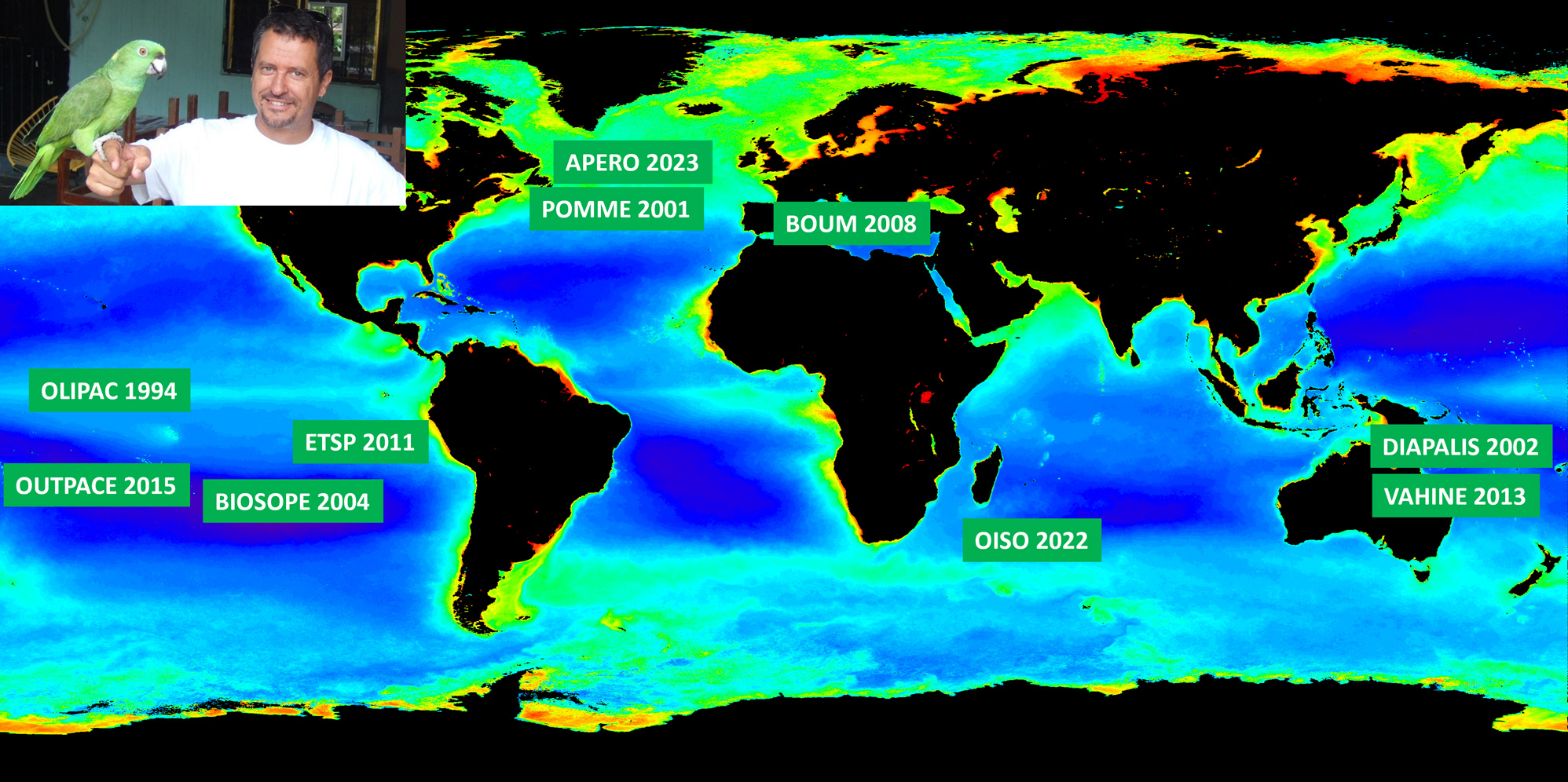
T. Moutin & T. Wagener (M1S2)
Objective
The aim of this lecture is to provide an in-depth understanding of ocean chemistry. Lectures cover the distribution of trace elements and radioactive isotopes to explain the workings of many oceanic processes. Lectures are complemented by the analysis and interpretation of trace element data obtained during an oceanographic operation in the coastal field.

Courtesy of Claudia Benitez-Nelson
► Theoretical lectures : 18 h
1. Minor elements (sampling and measurement methods, distributions and chemical speciation, profile types, origin of inputs (continental, sedimentary, atmospheric, hydrothermal) and impacts on distributions, scavenging, biological interactions).
2. Geochemical equilibrium of elements and major ion composition. Introduction of a quantitative concept to the study of internal ocean cycles.
3. Radioactive isotopes (notions of radioactivity: radioactive decays, decay law, radioactive families and secular equilibrium), applications to the study of processes in the marine environment (measurement of particle scavenging velocity, dating of sediments and measurement of sedimentation velocity, determination of diffusion velocity).
4. Organic matter (OM) in the marine environment: nature, origin and fate of particulate and dissolved OM. OM: qualitative and quantitative aspects (main constituents of OM, general distribution of OM). Fate of particulate and dissolved OM: abiotic (condensation, auto-oxidation and photo-oxidation) and biotic processes of OM degradation. Sequestration processes of OM . Molecular and isotopic approaches (delta13C and delta14C) for characterizing OM at the chemical level.
► Tutorial : 8 h
*Methods for sampling and measuring trace elements in the ocean: Critical studies of scientific articles.
*Introduction to methods for measuring and calculating chemical speciation in seawater (organic speciation and redox).
*Calculation of fluxes (continental, sedimentary, atmospheric, hydrothermal) and impacts on water column distributions.
► Practical work : 4 h
Chemical analysis of samples collected during an oceanographic campaign. Analysis and interpretation of the results obtained.